Categories
Uncategorized

Unsolicited business proposals to Microsoft: there is a way

My friend, Sean, has a post from January on how he’s not feelin’ the love so much from McDonald’s, specifically how the company doesn’t accept unsolicited proposals.

This was sent to me today:

http://www.mcdonalds.com/contact/contact_us/unsolicited_ideas.html

Not clear if he was offering a new spin on the Filet-O-Fish® or what… (and who knew that the bun has more calories than the patty?)  One of Sean’s comments on the blog noted that…

“Microsoft has no such policy [on unsolicited proposals]…The challenge is more likely that there are too many ways to give suggestions and feedback which makes idea management and follow up difficult. http://connect.microsoft.com/ is one such visible place.”

A commenter notes that Microsoft does have a general policy on unsolicited ideas…

Unsolicited Idea Submission Policy: Microsoft or any of its employees do not accept or consider unsolicited ideas, including ideas for new advertising campaigns, new promotions, new products or technologies, processes, materials, marketing plans or new product names. Please do not send any original creative artwork, samples, demos, or other works. The sole purpose of this policy is to avoid potential misunderstandings or disputes when Microsoft’s products or marketing strategies might seem similar to ideas submitted to Microsoft. So, please do not send your unsolicited ideas to Microsoft or anyone at Microsoft. If, despite our request that you not send us your ideas and materials, you still send them, please understand that Microsoft makes no assurances that your ideas and materials will be treated as confidential or proprietary.

OK, that’s pretty clear (and note that I formatted the type smaller than is displayed to save on space). But there is a flip side to this legal boilerplate.

I have noted previously that when you live in Oz, you have to remember what life was and is still like in Kansas.  We shouldn’t ignore new opportunities, but you can’t expect that an MS Wish like avenue will allow for proper vetting.  As a company, we recognized that we need a managed and scalable way to accept unsolicited business proposals.

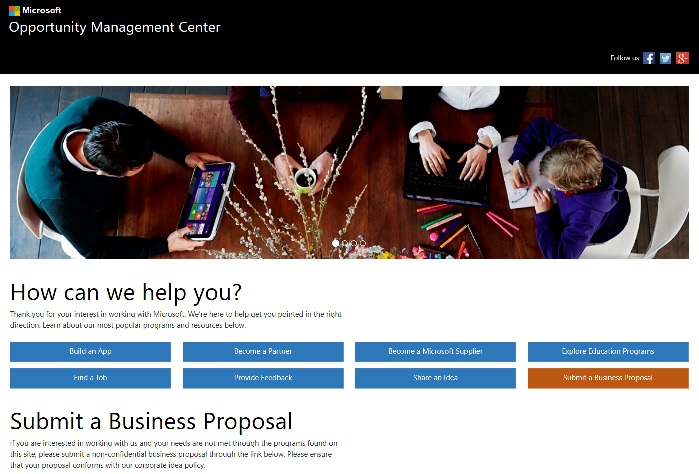
That’s why there is the Proposal Submission Tool at the Opportunity Management Center (OMC), a managed way for companies and individuals to submit their unsolicited business proposals to Microsoft.  The OMC’s tool was designed to provide potential partners with a managed way to submit business proposals to Microsoft.

“If you are interested in working with us and your needs are not met through the programs found on this site, please submit a non-confidential business proposal through the link below. Please ensure that your proposal conforms with our corporate idea policy.”

Remember, it’s for business proposals. There are other links on the page to help you connect with other services at the company 😉

Tags: Microsoft, customer satisfaction, Microsoft culture, Oz, business proposal.

Delicious Bookmark this on Delicious Bookmark and Share

Also available via http://bit.ly/b049uf

(Updated 20171025: corrected link to OMC)

Categories
Uncategorized

Get some satisfaction: article notes that “complaints can pay off with several basic steps”

NJ.com (The Times site) has an article this week, How to Get Some Satisfaction Customer complaints can pay off with several basic steps by Greg Saitz… 

“It’s likely almost every adult resident of New Jersey has felt stepped on and ripped off, insulted and ignored, bullied and browbeaten by a business or service provider.

“It’s amazing how so many businesses turn a deaf ear to things,” said Herbert Rotfeld, a marketing professor at Auburn University and editor of the Journal of Consumer Affairs. “I blame the impersonalization of things.”

Saitz writes that consumers have options and outlines the ways to complain, in a step-by-step format which he notes “should not only get a company’s attention, but also get results.”

I agree – and think that it’s a good list. 

“These suggestions come from Rotfeld; Susan Grant, director of consumer protection at the Consumer Federation of America; Bob Russo, president of the Consumers League of New Jersey; the National Consumers League and Consumer Action, a group based in San Francisco.

1. Take a deep breath and figure out what it is you want to say. Collect all the pertinent information [and have it available… and] find out what your rights are for the particular situation by calling a consumer rights group or governmental agency.

2. Make the call or write the letter/e-mail, but keep your cool.  Don’t yell…  But if you’re not getting anywhere with a rep, ask for their boss.

3. Go in person.

4. Go to the top. When sending a letter, direct it to the chief executive, president, etc.

5. Keep copies of everything. 

6. Turn up the heat. If you’re not getting anywhere with the company, file complaints with the Better Business Bureau, the state Division of Consumer Affairs or applicable regulatory agency.

For more, see my post on how to complain (and get results), in which I include a link to an article in the Seattle Times, “Firing of an e-mail? Make sure of your aim,” which offers a look at how an email exchange that lacks clarity can raise someone’s ire. (This was a response to my blog posting on emailing Steve Jobs.)

“I have seen my share of letters and emails on various issues and problems (even some notes of appreciation), some that are forwarded to me by execs to be routed to the right people in the product groups. I thought about what goes into a good email or snail mail note.

“So here are a few tips I thought of this morning while the kids were happily eating their breakfasts and watching mindless cartoons.”

Enjoy.

And read these ways to help when your trying to get service in a retail shop setting.

Tags: Microsoft, support, customer servicecustomer support.

Categories
Uncategorized

The Pros and Cons (or costs) around Daylight Saving Time changes

Yesterday, the Detroit Free Press presented two views on the changes to the schedule on daylight saving time in 2007: one that it saves energy and another that it doesn’t.  These read like a Point-Counterpoint discussion on ABC News, and my unscientific review of articles yesterday points to a majority of opinion that DST doesn’t save much if any energy or money.  In fact, it looks like it increases costs for businesses and headaches for IT Pros and systems administrators.

[Note: I wrote this article on Sunday after verifying that in fact the world continued to spin on its axis after the clocks all moved forward in the US and Canada.  Just posting it now prior to heading off to a working lunch meeting in a different building on campus.] 

The first is an article is by U.S. Representative Fred Upton (R-St. Joseph), who represents Michigan’s 6th Congressional District (http://www.house.gov/upton).  Along with Ed Markey (D-Mass.), representative Upton was one of the two authors of the extension to daylight saving time (which varies with calendars rather than a standard four week extension as Upton describes) in the US Department of Energy’s Energy Policy Act of 2005

“We based the extension on sound science — closely examining the Department of the Navy’s sun tables to determine that a four-week extension would maximize our nation’s energy savings.

“Fast forward to today. The American Council for an Energy-Efficient Economy estimates that the cumulative benefit of the four-week extension through 2020 will be a saving of approximately $4.4 billion and a reduction of carbon emissions by 10.8 million metric tons, cutting harmful greenhouse gases.

“Not only is extending daylight saving time an issue of conservation, it is also one of safety. Studies by a leading auto safety group have shown that extending daylight saving will save dozens of lives on our nation’s roads each year. Most accidents occur at dusk, but with the extended DST, our kids will have returned home from school and many folks will have completed their evening commute by sundown.”

The Free Press editorial, “Extended daylight saving time should be reset — it doesn’t save energy”rebuts that the first year with the new DST rules doesn’t save energy… but brings additional headaches…

“What it will do, for the next month or so, is keep sending kids out in the dark to wait for the school bus, make them less alert for the first hour of class and, as evening daylight keeps getting longer, less inclined to come inside to do homework or study.

“Farmers don’t like it much, nor do early morning exercisers and all those people who never seem to really wake up until daylight is coming in through the windows. The later switch in the fall also means little trick-or-treaters miss the fun of setting out on Halloween in the dark.”

Speaking of rug rats in search of sugary treats (we have two at home)… as I mentioned in “What do candy, Microsoft products and Congress have in common?” the change was of potential interest to one industry in particular: candy manufacturers, who reportedly lobbied for an extension to DST: this sunny extension will allow trick-or-treaters to scream “trick-or-treat” and collect candy for an additional hour.

Last fall, I saw a reference to a preliminary study for the California Energy Commission that showed savings during peak hours of 3.4 percent in March and 2.8 percent in November in 2007.  But again that seems to be a minority view: as I noted in a post last week, more recent analysis of the changes in Indiana concluded that DST doesn’t necessarily save energy (as noted here on NPR radio’s site).  The study in the report found that overall, Indiana households spent on average about $3.73 per household per year more on energy due to daylight saving time:…

“Against intuition and contrary to the entire point of government policy, the study found that daylight saving time resulted in an $8.6 million increase in spending on residential electricity.”

Also, I have not seen any follow up from the Dept. of Energy (DOE): as you may recall, in the Energy Policy Act of 2005, Congress retained the right to revert daylight saving time to its previous schedule as soon as the DOE had completed its assessment of the change in 2007.  I have only read passing commentary from the DOE, such as that noted in this link...

“Megan Barnett, a spokeswoman for the U.S. Department of Energy, said the jury still is out on the exact savings nationwide of extending DST.  “We did a preliminary analysis, based on decades-old information, that indicates a very small, or fractional amount, of energy savings,” she said.

My personal suggestion? 

Leave the 2007 DST change as it is.  Live with the new DST rules in the US and Canada. Don’t flip-flop with calendar changes. 

Or if you’re going to make a move to the entry and exit dates on DST, just make one final move and leave it at that.

Countries should closely consider the other incremental costs associated with such changes — in addition to the potential for energy savings — lest they discover after the fact that a “simple time zone change” or “small modified entry/exit date to their observance of DST” impacts more broad than within their own boarders.  Apparently Venezuela had that experience and found that making a sudden change so quickly or with little impact to industry is difficult, having delayed the move to a new time zone not once but six or seven times by my count. 

And if you are going to make a change, ensure that the DOE, Congress — or some government agency (including the venerable DOE, where the change originated before being signed into law) — advertises and promotes the change well in advance as we have seen with the transition to digital TV in the States.

None of this accounts for the changes consumers and professionals must make in their homes and in their businesses. In the technology industry, these changes are cause for many impacts in several areas, from updating computers and business systems to adjusting clocks and devices that are not able to keep up with these changes.

More on how we’re dealing with these changes later this week.  Now, on to lunch.

Tags: Microsoft, Indiana, Matthew Kotchen, Daylight Saving Time, Daylight Savings Time, RSS,DST. 3,530,000; 6,950,000; 649,000+
Categories
Uncategorized

Your questions: “How do I get updates to DST and time zone updates and alerts?”

Related to the regular updates made to our pages on time, Steven asked this week…


“Is there something that customer can plug into, like subscribing to monthly security alerts, for DST [and, I’ll add, time zone] updates?”


No, not directly. You can enable tracking for specific pages on the web (such as the the DST and time zone web pages) via RSS feed using free, third party services like page2rss, feedity, feedyes and other services.


I find that for updates to the pages linked off of http://www.microsoft.com/time — such as the Hot Topics and impacted Microsoft product list — services such as Feedity work well.


This approach also works for tracking the changes made to Knowledge Base (KB) articles, such as the December 2007 cumulative time zone update for Microsoft Windows operating systems (KB 942763).  As we update the article — particularly when the KB is superseded by a new update — you’ll get pinged.


As Sean noted (and reminded… thanks!) you may also want to leverage the RSS feed for the Technet/MS DST Blog at http://blogs.technet.com/dst2007.

You can also apply this to external, public resource sites such as those on the TimeandDate.com site…


… the tzdatabase page, the list of time zones wiki and the overall time zone Wiki page.

Tags: Microsoft, Daylight Saving Time, Daylight Savings Time, RSS, DST. 3,530,000 (down a million items); 6,950,000; 649,000+

Categories
Uncategorized

PC Magazine: Phony e-card site serves up malware

A quick note before lunch…  per PCMAG today… there are a number of phony electronic cards being circulated this Valentine’s day…

Sunbelt Software is reporting a virulent and convincing fake greeting card site and associated malware.

Like most malware these days, it is delivered through a rogue web site. The link to the site is in an e-mail spammed out to victims as a greeting card. When you click the link you are told you need to update your Flash player to view the card.

See American Greetings Phony Site Serves Malware With A Smile – Security Watch for more details, and don’t open suspicious emails from someone you don’t know.  Also see Pleasure, pain for investors on love’s day (Chicago Tribune).
