An AI look at the concept of ikigai in the new year, courtesy of Microsoft Office Stock Images
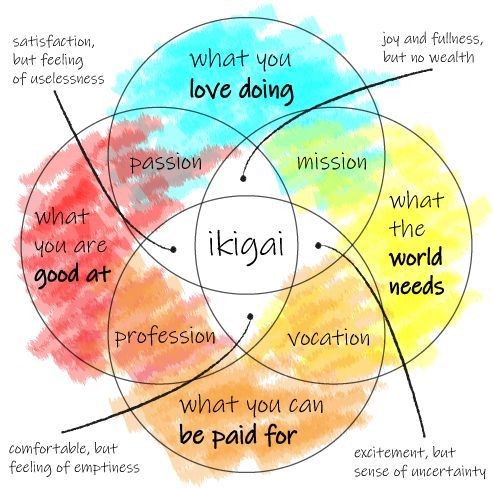
tl;dr: As the year comes to a close, many of us reflect on finding more purpose and meaning. The popular ikigai Venn diagram promises a formula: find the overlap between what you love, what you’re good at, what the world needs and what you can get paid for.
But this myth misses the mark on the original Japanese concept. Rather than a destination, ikigai is a journey. It’s about starting small, releasing yourself, seeking harmony, appreciating little joys and being present. I present Mogi’s framework as a way to help identify and sharpen focus on the everyday meaning as we enter the new year.
I hope that Mogi’s insights will help you explore a wider spectrum of life’s diverse joys and purposes. Challenge the assumptions and assertions that purpose is an intersection of concepts on a page. Instead, discover ikigai through living life more fully.
Ikigai
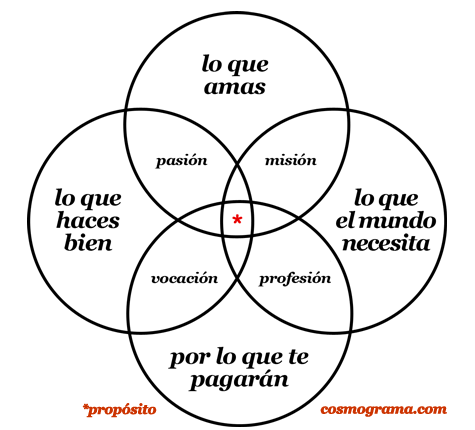
You may’ve seen a popular take on ikigai in a popular and often used Venn diagram widely shared on social media (such as here and here) and in self-help books, depicting it as the intersection of four circles: what you love, what you’re good at, what the world needs, and what you can be paid for.
“Full credit for the Venn diagram of Purpose should go to Spanish author and psychological astrologer, Andres Zuzunaga, who created it in 2011. It first publicly appeared in the book Qué Harías Si No Tuvieras Miedo (What Would You Do If You Weren’t Afraid?) by Borja Vilaseca in 2012. Eventually, the diagram was translated into English and then started being used by HR managers and life coaches as a simplistic overview to finding purpose in your career. It is now used to help people create a more balanced work situation.”
Andres Zuzunaga, Proposito. 2011,
Ikigai history
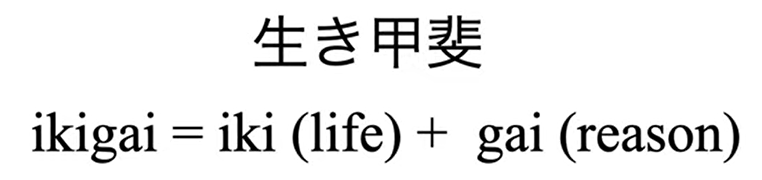
A little history. Based on what I’ve read about and discussed ikigai throughout my career, Ikigai is Japanese for “life” (iki) and “reason” (gai), which roughly translates to “a reason for living (or being).”
Courtesy Ken Mogi, The true ikigai diagram (YouTube)
I subscribe to Ken Mogi’s outline that the real ikigai is not a formula for finding your purpose. It’s a way of living that embraces the joy of being alive. Japanese people don’t use this diagram, nor do they ask themselves the four questions that it suggests. They just follow their ikigai.
It’s not a goal, destination, or something you find, but rather a journey, or something you feel and experience. It’s dynamic and can be highly personal and diverse. And ikigai isn’t limited to your work or the path of career but includes all aspects of your life: just scratching the surface, it’s your relationships, your passions, your hobbies, your values, and even your dreams.
Pillars of ikigai
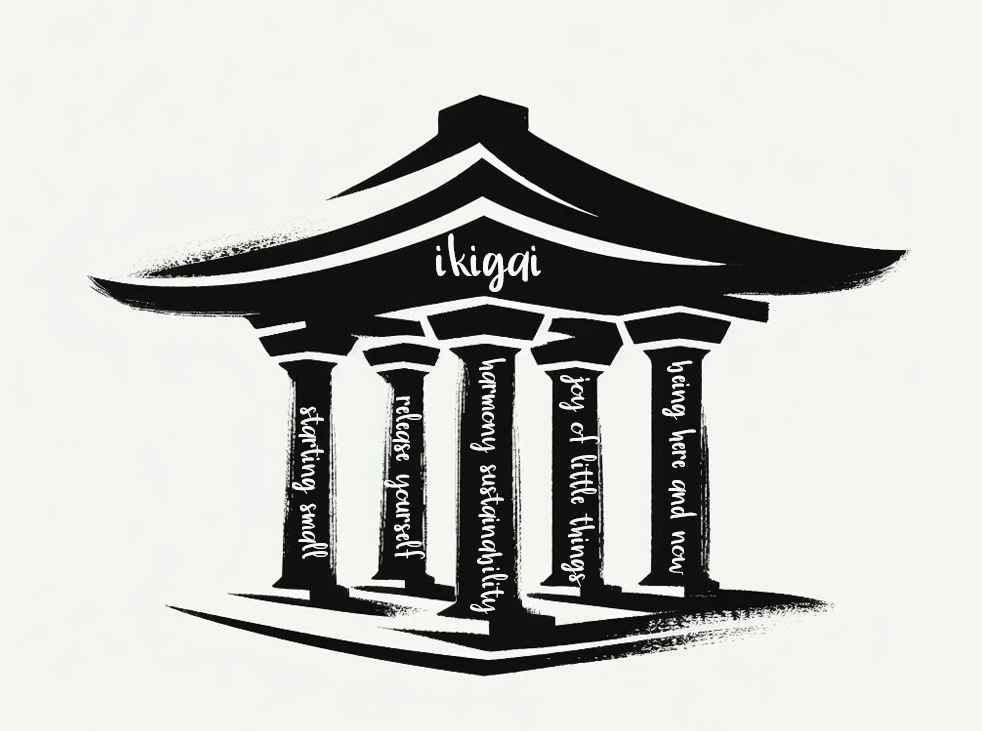
In his book, The Little Book of Ikigai, Mogi introduces five pillars of ikigai that provide a supportive framework and can help you awaken and cultivate your ikigai in everyday life:
Starting small: focusing on the details and appreciating the small things that make you happy.
Releasing yourself: accepting who you are and expressing your true self without fear or judgment.
Harmony and sustainability: relying on others and contributing to the common good.
The joy of little things: enjoying sensory pleasures and being present in the moment.
Being in the here and now: finding your flow and immersing yourself in what you do.
An updated view of Mogi’s Pillars of Ikigai
Rather than hard and fast prescribed rules, Mogi’s pillars are guidelines and suggestions, intended to be provocative and complementary, while flexible enough to be used creatively and experimentally. They are not based on scientific evidence or empirical data, but on cultural wisdom and personal stories. Mogi writes…
“They are not mutually exclusive or exhaustive, nor do they have a particular order or hierarchy. But they are vital to our understanding of ikigai, and will provide guidance as you digest what you read [in his book] and reflect on your own life. Each time they will come back to you with a renewed and deepened sense of significance.”
Representing ikigai
The four-circle diagram of ikigai above may be appealing and convenient, but it’s misleading and incomplete. It reduces ikigai to a formula that can be applied to anyone and anything, but ignores the complexity and diversity of human life. It implies that ikigai is a rare and elusive phenomenon, but it neglects the abundance and accessibility of ikigai. And it suggests that ikigai is a product of optimization and maximization, overlooking the importance of exploration and experimentation.
Ikigai is much more than the popularized diagram and the chance intersection of four key mystical ingredients: it’s a spectrum that reflects the richness and variety of what makes life worth living, and a growth mindset that enables you to embrace and enjoy the challenges and opportunities that life offers. Mogi offers that what you’re good at, what you love, what you can be, what the world needs… these can all be your ikigai:
“It’s all the diversity… the whole spectrum is what’s so important. The whole area [in the popular Venn diagram] should be your ikigai.”
He goes on to suggest that there are four categories to consider in a true ikigai diagram: Small, Big, Public and Private. I represent these in the following way, adding some structure to his white board outline:
“In your life, there are small joys and big joys and purposes, and also there are private and public joys and purposes: ikigai is all of these things. The idea of ikigai is very democratic… a whole spectrum of the diversity of things that gives your life some deeply rooted joy… all of this is ikgai.”
An updated ikigai diagram representing Mogi’s four categories (clockwise from to left): Small, Public, Big, and Private.
Quite simply, ikigai is a philosophy that can inspire you to live authentically and meaningfully. It doesn’t depend on external forces and material things – recognition, fame, or wealth – but on internal and deeply personal ones, such as fulfillment, joy, satisfaction. It comes about and is developed through your own intuitive discovery rather than methodical and rational calculations: more emotion than a matter of logic.
Ikigai isn’t something you find through a chance intersection of components outlined in a blog post: it’s something you do.
Please let me know what ikigai means to you. Is it something to find, or a way to experience life more fully?
Here’s a question: have you thought about how you leave a lasting impact on your customers and colleagues?
Over the last few years in dozens if not hundreds of meetings and discussions at Microsoft, I’ve shared some of the guidance and thoughts by the incredible Bill Buxton, which I’ve kept at the top of my OneNote notebook:
Ideas are a dime a dozen (or you are doing it wrong)
Complementary, not competitive
Work together, not in silos
Everyone has their own problems to solve and opportunities to make a creative contribution to the final product
Reviewing past games (case studies) can be a good place to start
Impact is something that’s been on my mind over the last several weeks as I’ve leaned in to help others after a layoff (both those departing and those who remain), some to find new roles, answer their questions, help plan on how to address new opportunities and concerns at work, assuage their concerns, and generally be there for them.
And one red thread through all of these conversations has been an ask for advice, much of which has boiled down to this.
TL;DR
In a nutshell, it’s not about being the smartest or the most talented, it’s about being truly customer-driven and obsessed – not just lip service or a corporate tag line. It’s about knowing what makes our customers truly successful and achieving their business goals inside and out, using data and insights over opinions, and partnering with other groups to close the loop. It’s about speaking truth to power (always in a most respectful but provocative way) and finding work-life integration. And above all, it’s about leveraging and building on such practices every day.
As I retire today (a little earlier than planned given the wave of industry layoffs, but a little later than originally scheduled and just as welcomed) and look back on my time at Microsoft, let me share some advice that has served me well and often shared with others over the years.
Be customer-driven and obsessed
Always put the customer first and strive to understand their needs and wants. This will help you deliver exceptional service and build strong relationships. If people remember one thing about my time in the industry, let it be how I promoted this cause and effect each day.
Being customer-driven means putting the needs and wants of the customer at the forefront of everything you do. This involves understanding their pain points and working towards finding solutions that address them. One way to achieve this is by actively seeking feedback from customers and using it to improve your products or services.
“No one ever made a decision because of a number. They need a story.”
Those are powerful words from Daniel Kahneman on wrong numbers (nytimes.com). It’s not enough to simply collect data on our customers: we have to do better to really and truly understand their needs and wants so we can deliver the exceptional service they deserve and build strong relationships that last beyond a sales cycle. By being customer-driven and obsessed, we can create meaningful connections that drive success for both our customers and our company. This is also one of the steps towards creating successful habits that Charles Duhigg has written about (in his book, The Power of Habit), and a key to understanding what drives customer behaviours. When you take the time to get to know your customers, you can use that knowledge to drive your actions that benefits you both.
Be an impartial voice for customers
Advocate for the customer and ensure their voice is heard within the company, as it will help improve the customer experience and drive loyalty.
As an employee, it’s critical to act as an advocate for customers within your company. This means speaking up on their behalf to ensure their concerns are heard and addressed – listen, act, and drive impact (more on the OODA loop in a moment). I’m reminded by Marcus Buckingham that the best managers know that their job is to help people fall in love with the work they do. (See also What Great Managers Do on hbr.org) By being an impartial voice for our customers and advocating for their needs, you improve the overall customer’s experience and drive loyalty.
But it’s not just about meeting their needs, it’s about creating a connection that inspires them to love what we do. When you truly advocate for the customer and take the steps towards improving CX, loyalty, brand love (more on that from Microsoft’s CMO Chris Capossela in Selene Suau‘s post), you find those key factors in what Richard Holden (author of Loveability) said…
“… the most successful companies are those that listen to their customers and act on their feedback.”
Know what makes the customer successful, inside and out
To truly understand your customers, it’s important to know what drives their success. This involves understanding their business goals and objectives as well as their challenges and pain points. By having this knowledge, you can provide tailored solutions that meet their unique needs. Today I was discussing Angela Duckworth’s book (author of Grit) with one of the folks on my team at lunch and her maxim:
“Passion for your work is a little bit of discovery, followed by a lot of development and then a lifetime of deepening.”
By taking the time to truly understand your customers and what makes them successful, you can develop and deepen your relationship with them to provide solutions that not only meet their needs but exceed their expectations. That’s often a delicate balance: you may find that you’re defined by what you’re willing to struggle or wrestle with when it comes to truly understand customers. It’s imperative to know what drives their success: it’s not just about meeting their needs, but about understanding their struggles and helping them overcome them. By knowing what makes our customers successful inside and out, we can build stronger relationships and deliver exceptional service.
Data and insights over opinions
This is something that I heard once again from key executives at Microsoft when we embarked on a new and ambitious project just a few years ago. They told me quite pointedly that to affect change and show credibility, we needed to use and frame customer data and insights to inform decisions rather than representing or relying on opinions. I came to learn that it helps you make more informed decisions and drive towards better outcomes, presenting key points and recommendations backed by evidence. That’s one way that employees can consider and bring all options to the table before making a decision. As Duhigg once said…
“Data can tell us what we need to know. It’s our job to turn that data into insights.”
By relying on data and insights rather than personal opinions, employees can make more informed decisions that benefit both themselves and the company.
The words from Daniel Kahneman are also quite clear in my head: “We can be blind to the obvious, and we are also blind to our blindness.” In this case, it reminds us that it’s easy to fall into the trap of relying solely on our opinions when making decisions. But by using data and insights to inform our choices, we can make more informed decisions that drive better outcomes. And egos may need to be pushed aside: it’s not just about being right but being rigorous in our thinking and open to new information. (Also see “We Are Blind To The Obvious And Blind To Our Blindness”)
Make the connections, close the (OODA) loop
I’ve shared a lot about the OODA loop at work (Observe, Orient, Decide, Act, referenced previously), and it’s one of the strengths when it comes to navigating a company of the size of Microsoft over the last two decades. Leveraging the model of the #OODA loop provided a framework to connect with other teams across Microsoft, to share information and collaborate on initiatives. It helped me and my teams drive the “close the loop” efforts we needed to be more effective, and ultimately ferret out issues and leverage new opportunities that contributed to revenue, consumption, and share. These connections and collaboration across varied and sometimes different teams was essential in closing the OODA loop, leading to better decisions, increasing agility (which is tough with more than 200,000 people) and making us act with a greater sense of urgency. As Stephen Covey said:
“Synergy is what happens when one plus one equals ten or a hundred or even a thousand! It’s the profound result when two or more respectful human beings determine to go beyond their preconceived ideas to meet a great challenge.”
Partner with other groups
Building strong partnerships with other groups across Microsoft has been key to driving collaboration and innovation, and probably should’ve been near the top of this list. By working together and sharing ideas, teams can achieve more than they can alone. And this can help employees leverage a broad, collective knowledge and expertise across their own company to achieve great things. Some of the benefits I’ve experienced:
Greater investments in time and attention: Partnerships can help us access more resources and attention to projects and initiatives.
Bringing new perspectives and varied expertise: Connecting can help us learn from different viewpoints and skill sets that complement our own.
Support when we need it: It can help overcome challenges and difficulties by providing emotional and practical support, gaining insight and guidance from their experiences. Partnerships also help diversify our views and reduce risks.
Sharing the costs, material and psychological: Bringing teams together to solve big problems can reduce costs by sharing the load of the work as we drive solutions.
As I’ve found in listening to and reading Adam Grant, as people help each other they improve their collaboration, creating a culture of cooperation and mutual support. Grant argues that helping others is not only good for them but also good for ourselves. He calls this “givers gain”, meaning that those who give more than they take tend to achieve more success and happiness in the long run. Grant suggests a few different ways to foster a culture of giving across teams:
Be proactive: Don’t wait for others to ask for help – offer it before they need it.
Be specific: Don’t just say “let me know if you need anything” – offer concrete ways you can help.
Be generous: Don’t limit your help to those who can reciprocate – help those who can’t or won’t as well.
Be humble: Don’t brag about your contributions, the ego monster remains with others long after you’ve left the building – acknowledge the contributions of others.
Striving for a healthy balance between work and personal life is essential for overall well-being, and by integrating these in a way that works for you can lead to greater satisfaction and fulfillment in many different areas of life. I’ve heard it said that there’s no such thing as work-life balance: there’s work, and there’s life, but rarely is their balance. I’ve shared that instead there’s a level of integration that you can strive to achieve, as it can be challenging to find the right balance between our professional and personal lives. Striving for integration rather than separation enables you to create a healthier balance that works. It’s not just about finding time for both, it’s about finding meaning in both. Stephen Covey said…
“The key is not to prioritize what’s on your schedule, but to schedule your priorities.”
By focusing on what truly matters and finding ways to integrate work and personal life, you and your teams can get a healthy balance that benefits both themselves and the company – and it’s up to you to maintain and reinforce it.
Speak truth to power
This is a big one for me (perhaps I should’ve listed it first), and probably the one I’ve echoed more in the last few months and quarters/years than the rest of my career combined. I attribute that more to the wisdom that comes from experience, less about bravado or ego.
IMHO, it’s critical that you lose the fear to speak up when something isn’t right, runs off the rails (or as one favourite and passionate exec shared with me, asleep at the switch), or when you have an idea of ways to improve things. To paraphrase Maya Angelou, you need courage to practice other virtues consistently. By having the courage to speak up and share your thoughts and ideas, you can help create positive change within the company. As Adam Grant wrote in ‘Originals,’ you have to…
“Argue like you’re right and listen like you’re wrong.”
I get it: it can be intimidating – even career limiting – to speak truth to power, but it’s essential for driving change and fostering innovation. By speaking up when something isn’t right or when we have an idea that could improve things, we can make a difference. Plus, it’s not just about being heard, it’s about being courageous in our convictions and open to feedback. (See also ways to develop a work culture that values respectful dissent).
Rinse, lather, repeat
Continuous learning is essential for personal and professional growth. By learning from your experiences and applying those lessons moving forward, you can achieve greater success and fulfillment. As Carol Dweck (Growth Mindset), said…
“If parents want to give their children a gift, the best thing they can do is to teach their children to love challenges, be intrigued by mistakes, enjoy effort and keep on learning.”
By embracing challenges and learning from mistakes, employees can continuously improve and achieve their full potential. Also from Grant’s Originals, “The hallmark of originality is rejecting the default and exploring whether a better option exists.” It’s essential to continuously learn from our experiences and apply those lessons moving forward. By rinsing, lathering, and repeating, we can drive innovation and growth. It’s not just about doing things differently, but more about doing things better.
Epilogue
I hope this is beneficial and enables you to do things a little better in your career and life, as it has served me so far in mine. Let me know your feedback (being a learn-it-all 😉 and feel free to share the advice that has helped you in your career. In the immortal words of Lou Reed: “You can depend on the worst always happening. You need a busload of faith to get by.”
“You cannot connect the dots looking forward; you can only connect them looking backwards. So you have to trust that the dots will somehow connect in your future. You have to trust in something – your gut, destiny, life, karma, whatever.” – Steve Jobs
“We think a lot about those black lines: the roads not taken, the opportunities missed, the ones that got away. But most of us greatly underestimate the size of the lush green tree of possibilities that lie ahead of us.
Impacts of your decisions
“We cannot live only for ourselves. A thousand fibers connect us with our fellow men.” – Herman Melville
I’ve thought a lot about that simple diagram and the impact our decisions can have on our work and in our lives, impacting not only our own life paths (and levels of work/life harmony) but impact the people and teams around us.
Years ago, when I was in the Windows division at Microsoft, my team examined and assessed the scope and impact of our decisions that we made about our products and services. Studying emails and chats long before the analytics Microsoft Delve and now Viva Insights, we did a detailed yet still rudimentary assessment of how many people and different groups would be affected by the proposals and decisions we made.
After going through the cascades of people and managers and leaders that we needed to talk to, influence, and convince, we found that on average a simple decision might impact at its core a few dozen or more people and as many teams – on average, around 30 people from different teams. But over time, considering Windows was the underpinning support for many products and services at Microsoft, the decisions could ultimately have an impact on hundreds of people and groups in various divisions at the company… and further, on thousands upon thousands of companies in our ecosystem, and millions and millions of our customers around the world.
Concentric circles of engagement
I’ve often referred to these connections initially as concentric circles of engagement (with apologies to the circles of trust or Silicon Valley’s venerable and amusing “Conjoined Triangle of Success”), a play on the spheres of influence and leveraging what could best be described as an archery target (complete with bullseye at the centre) with ever extended rings. Each of these rings representing the connections in your relationships (from closest to casual): at the centre for me is my immediate family and a small number (fingers/toes level) of close friends – in my case, a total of no more than 6 or 7 people, certainly less than a dozen. The next ring includes extended family members and the closest co-workers with whom I have a relationship, which encompasses less than two dozen people. After that, the ring includes more people from my immediate social sphere from neighbours to friends that I catch up with on an infrequent basis; in the last are my distant relatives, old friends, industry and business relationships. (Beyond that is the Oort cloud of connections in the social sphere many made up of virtual connections, most of whom I’ve never met in person or spoken with live.)
Years ago (and seasonally relevant), the evolutionary psychologist Robin Dunbar and anthropologist Russell Hill looked at the web of holiday cards sent by an average family. They found that a quarter of the cards were sent to family members, while friends received nearly two-thirds, and colleagues received 8 percent. At the centre of the study was the total eponymous number of cards sent out: 153.5, or on average, about 150. Going through my own set of social sphere connections, I believe my own Dunbar number is closer to 250. (I’ve excerpted this from Drake Bennett’s article, “The Dunbar Number, From the Guru of Social Networks” where you can read more about this work.)
Each of these bands can also represents the level of comfort with each of these, from most intimate to more distant or remote. This means that with the few people at the centre, that’s the zone where you’re most comfortable zone with your closest and deepest connections. At the outer edge, the ones where you’re comfortable in casual conversation and engagement.
That’s a lot to take in.
The impact of your decisions and actions
“We cannot change the cards we are dealt, just how we play the hand.” – Randy Pausch
In life, there are your friends and family – the rings closest to the centre of your concentric circles – where decision might directly affect these people closest to you, particularly when the changes involve where and how you’re living, finances, personal relationships, or your career. And depending on the nature of your decision, it could have far-reaching impact on your broader set of relationships – those rings further out in your own circle – including the people in your local neighbourhood and community, colleagues and connections (such as many of the people on LinkedIn and other social media sites that your follow), and members in your other IRL social circles.
At work, you have to consider the immediate teams involved in implementing or being impacted by your proposals and decisions, ranging from individual contributors and peers, executives and leaders, and all of the people in between. Then there are those who may be indirectly affected: other departments or teams that might feel the impact of a decision’s downstream effects. Finance, operations, marketing, sales teams, customer service, and even other product development groups. And then when you’re considering products that are part of and empowering a vast ecosystem of external stakeholders, you have to consider customers, partners, and suppliers, and even investors and regulators.
Impacts of your connections
“Everywhere was connected to everywhere else.” – Terry Pratchett
Imagine an update to Urban’s diagram, here the various black paths on the left side of a diagram converge to that same single point, each path representing the various decisions, interactions, and outcomes that contribute to where and who you are at this moment in the centre. And then looking to the right side of the paths (the future) you see the possible green paths you might select and the different life paths open to you.
There’s another dimension to this, which is the intersection of the life paths from others, meeting and intertwined with your own green lines, with the potential at each decision point for a new (perhaps, blue lines) branches, representing the many other choices you could make, the paths you might follow. In some cases, the paths and options are clear (most often those nearest to where you are in the moment). And as time progresses, these blue lines would then branch out farther in your life paths, with each new decision point leading to even more possibilities, and further impacting the paths of others in your orbit.
In the article, “The Ripple Effects You Create as a Manager”, author Monique Valcour looks at the impact of a leader’s decisions and mindset on people and teams at work and affect how we experience and respond to different situations. The impact and interactions of our decisions often affect more than just a single person and can have subtle yet profound impacts on those around us. And I appreciate that Valcour cites Adam Grant’s book “Give and Take” illustrating that when we adopt and projecting such a generous mindset, it can result in fostering trust, transparency, and positive behaviours with those around us.
What also struck home with me was the look at a 20-year study of healthy employees: it found that people with strong social support from the people they work with were two and a half times less likely to die prematurely than those without a strong level of support. To me, it reaffirms the importance of these supportive connections with others in your concentric circle at work, doing more than just improving the harmony of your work and life, but also emphasizes the importance of how being connected can be a net positive for your health and longevity.
Epilogue
“The Road goes ever on and on, Down from the door where it began…” JRR Tolkien
While your own life path diagram may be quite complex, with a multitude of black, green, and blue lines crisscrossing the page (in reality, the number of potential life paths is virtually infinite), you begin to realize that every decision you make, big or small, leads to a new set of possibilities. (I’ll leave you to grapple with Urban’s post on “Putting Time In Perspective”.) And though you may think that you can quantify the impact of those impacts and potentials as I did many years ago, you come to find that the impacts may be more far reaching than you could have imagined.
Your own potential future is vast, and you’re not limited to a basic immediately apparent or obvious paths. There are endless possibilities, and you have the opportunity and the ability to choose the ones you want to explore… and hopefully prioritizing how to best spend your time to do so.
Have you ever felt overwhelmed trying to get your resume noticed among the sea of applicants at a dream company?
I’ve received a lot of questions over the course of my career at Microsoft on how to apply for a job with the company – and several more just today (in response to a recent post) from folks on LinkedIn. With over 200,000 employees worldwide and millions of job applications submitted each year, it’s an incredibly competitive place to break into. But with the right preparation and approach, it’s possible to stand out from the multitude of applicants.
As a manager and leader who’s reviewed countless resumes, interviewed many hundreds of candidates, and hired many employees during my career at the company (plus having gone through the hiring process myself), I wanted to share some tips that helped the best candidates put their best foot forward. In addition to the tips from Microsoft Careers, here are some additional ones that may help strengthen your approach and efforts.
Start at the beginning
Whether you are eyeing a technical or business role, an entry-level position or more senior leadership, there are a few strategies can help position you for success:
The first step is to create your profile on the Microsoft Careers website (https://careers.microsoft.com), a great place to start for more insights on specific roles. There you can search for jobs that match your qualifications and interests. Once you’ve applied, you can also set up job alerts to receive updates and track the progress of your applications.
Research Microsoft roles posted on LinkedIn by peers or recruiting managers. There’s a lot of jargon and specialization of roles and responsibilities at the company, and once again, this is where the Careers site can help you learn about roles at the company.
Update your LinkedIn profile to showcase relevant skills, projects, and achievements aligned to the roles you are pursuing. Microsoft recruiters often leverage LinkedIn to source potential candidates. There are lots of recommendations on LI, and I particularly like the advice from (the very smart) Heather Hamilton and the guidance in her articles and posts.
Watch for roles posted on LI and other social media sites. If you are already connected, great! If not, look at your degrees of separation and if you’re within one or two connections, leverage them to help you get an introduction and recommendation for the role. When you find a role posted by a hiring manager or shared by one of their contacts, make a connection.
Connections are key
Leverage your personal contacts. When you have friends at Microsoft and are persuasive and convincing, they can submit your resume for consideration. Rinku Thakkar said that talent teams rank employee referrals as the most important source). Here’s the twist you didn’t expect: less than a third of people actually ask their contacts to refer them for a job.
Then, reach out with a personalized message, and explain why you’re interested in the role and how you’ll impact the team. Share the job description, your resume, and ask if they can refer or introduce you. I’ve consistently read that referred candidates are twice as likely to get interviews and five times as likely to get job offers. (And referrals are beneficial for hiring managers, as nearly half of referral hires stay for three years or more, compared to less than 15% of those hired from job boards.)
Target specific teams and product groups that match your background and passions. Articulate why those groups excite you and how your skills would add value. Each has unique visions, strategies, and cultures, and it’s important to find a genuine fit with your skills and interests. Also, knowing what drives Microsofties and what’s valued most at the company is important: see https://www.microsoft.com/en-us/about/values and https://www.microsoft.com/en-us/about/corporate-values.
Know what there is to know about the role which you’ve applied for: prepare for questions about real-world problems in the role and group. This is your opportunity to demonstrate critical thinking, creativity, and ability to collaborate with others. Be ready to communicate ideas clearly and succinctly.
Show that you’re curious, have a growth mindset, and are adaptable. Microsofties value applicants who can handle ambiguous situations, embrace uncertainty, listen to and learn from feedback, and are open to new perspectives and approaches.
Most of all, be authentic! It’s your opportunity to express yourself with confidence and humility. While rehearsal is important, being genuine goes a long way, as does being respectful, transparent, and (always) honest.
I hope these tips help guide your application and preparation, and I’ve included a few more in the links below. Here’s wishing you much success with your application to Microsoft!
I have a confession to make: I love writing thank you notes.
When you get a genuine “thank you” note from your manager or peer (or as I clearly recall, the CEO), it makes an indelible impression.
With respect to Erin White (ironically, their Bureau Chief for – gasp – Personal Health and Wellness!) at The Wall Street Journal today, (https://www.wsj.com/health/wellness/lets-be-done-with-thank-you-notes-573a97c6) I disagree that “it’s time to send the handwritten thank-you note the way of the horse and buggy.” (Perhaps one secret to happiness: lower your expectations and the credence you place in advice from those looking for a provocative headline. 😉
Writing thank you notes may be seen by some as a waste of time and energy, and they’re on to something, given that some notes are often insincere, formulaic, and ineffective. Others may think that thank you notes are outdated and irrelevant in the digital age, and don’t reflect the true value of the recipient’s action, gift, or your relationship.
As TEDx speaker and author Christopher Littlefield shares in his HBR article, How to Write a Meaningful Thank You Note, a thank you note should include specific details about the gift or gesture, explain why it was meaningful, and how it made us feel. All of these elements can make your thank you note more authentic and memorable, which can create a greater and lasting impression on the recipient.
Sending a personal note isn’t just polite and respectful, it’s also a thoughtful way that can add to our personal well-being and happiness. Personally, I’ve found that thank you notes can be meaningful and important ways of showing appreciation and recognition – and they don’t have to be lengthy War and Peace diatribes: a quick letter of appreciation can provide benefits for both you and the recipient. And did you know that writing thank you notes has personal benefits, helping make you happier, healthier, and more successful?
Remember, writing thank you notes is a valuable and meaningful investment in your relationships as well as yourself. They can adapt and evolve with the changing times and needs. So, don’t be done with thank you notes. Genuine thank you notes are personal ways to express your appreciation and gratitude beneficial and rewarding, and timeless and relevant, and how to write them effectively. Embrace and enjoy the time you take to reflect and write them to those you appreciate, with gratitude (thanks, Amy).
TL;DR: Communication skills are essential for personal and professional success, but they are not always easy to master. Sometimes, it can be even more challenging when you’re addressing leadership –people who may think of themselves as excellent communicators – may not be practicing the active listening and mentoring they may regularly espouse.
Sally: “The fish is talking.”
The Cat: “Well, sure, he can talk. But is he saying anything? No, not really.”
– Dr. Seuss’ The Cat in the Hat 2003
No matter what you may think of the film, Mike Myers plays a mean Cat.
And his rhetorical question posed to the children is the way he brushes off the fish’s protests about the trouble he is about to cause, implying that the fish is not really communicating. The Cat is drawing a sharp distinction between saying something and nothing, and that the children should tune him out.
Have you been in meetings like this?
Or worse, have you been the fish with leaders in the position of The Cat, seemingly manipulating your language and logic, cutting into your position and questioning your conclusions and plans?
Now, picture yourself for a moment as a leader in a presentation, a person who has access to more information than anyone else in your organization. (And you may not realize this is an accurate portrayal of your current role and position.) You might think you have a clear picture of what’s going on, but are your preconceptions preventing you from hearing about what’s truly happening from those closest to the topic and action?
In her posts on Communication Matters, Dr. Dawn Braithwait writes that “whether we are negotiating whose turn it is to feed the dog, how to become a parent, how to interact with a difficult co-worker, or how to celebrate with a friend who won a major award, it is in communication that we learn what to do and say.”
For the fish
I’ve read previously that there’s often a gap between how speakers rate their own communication skills and how their listening peers and leaders rated them. No surprise, researchers found that those who felt they were effective communicators ended up overrating their communication skills in four key areas (interpersonal, small group, public speaking, and mass media) as compared to how their audience evaluated them.
Reading Perceiving and Presenting Self – Communication in the Real World (umn.edu), we may often think of ourselves as fixed and stable, but our self-concepts are more fluid and malleable than we realize. In the article, the authors look at how we might perceive and present ourselves when we communicate, and how we can improve our own self-awareness and understanding.
How can you communicate better with leaders who think they know it all? Here are some tips to help you avoid the common pitfalls and improve your communication skills:
Communicate nonverbally. Your voice, gestures, posture, and facial expressions can enhance or undermine your verbal message. Be aware of how you use them. Use nonverbal methods of communication to reinforce your points: lean in, show interest and enthusiasm, acknowledge what you hear through your emotions, and strive to make a good impression.
Regulate your emotions. It’s amazing how much this can help or hurt how you communicate. When you regulate how you react, it can help you connect with others, with greater authenticity — but it can also cloud your judgment and may even distort your message. Identifying and recognize your emotions, accept and manage them. With a heightened level of emotional intelligence, you can also better understand the emotions of others and then respond accordingly.
Ask for feedback. Feedback is important in so many areas where we connect with others, and it’s vital for improving communication skills. Be sure to ask for feedback from your colleagues, mentors, managers, and coaches on how you communicate and ways that you can improve. Look for feedback from yourself by looking back on your communication experiences and assess how you did, thinking about what you could do differently and improve on your performance in the future. Use the feedback to find your strengths and weaknesses, set goals, and track your progress.
Practice, practice, practice. Public speaking or talking to an audience (giving a presentation, a speech, or a pitch) is a learned skill just like any other… and one you’ll likely need to master in your career. It can help you develop your confidence, clarity, persuasion, and influence skills. Make sure you take the time to prepare in advance, know your audience, and rehearse what you’re going to say. Make sure you have a clear structure, use visual aids, practice your delivery, and do your best to manage your nerves.
One of the approaches I’ve recommended to my teams and mentees in the past is to participate in organizations that build these skills such as Toastmasters International (a great organization and one that provides safe peer feedback and camaraderie) and even acting lessons. What I’ve learned in those activities has helped me communicate messages more effectively and confidently.
And a note for The Cats
Leaders, you play more than just a supportive role in these situations. As the authors noted in Are You Really Listening? (HBR), when you’re the executive absorbing the communication, you may be in a bubble where the information you receive is often filtered or distorted. And this is done (good or bad) by the people who want to not just provide information but please you, protect you, or even (hypothetically/illustratively) manipulate you. The bubble can isolate you from the reality and make you miss important signals: opportunities, challenges, junctions, dangers, and more. In this situation, the authors offer a three-step solution:
Listen actively yourself. Don’t just hear what people say, but try to understand what they mean and how they feel. Use techniques such as asking open-ended questions, paraphrasing, summarizing, and acknowledging emotions to show your interest and empathy.
Create a listening ecosystem in your organization. Encourage feedback, candor, and curiosity from diverse sources. Reward those who speak up and challenge the status quo, and foster a culture of learning and innovation.
Stay hypervigilant for listening and demonstrate it. Constantly look for signals and patterns in the environment, seek out different perspectives and viewpoints, and challenge your own assumptions and biases. Model, coach, care is an imperative as others in the room will be watching you, taking their cues on where to press, what to raise in importance, and even how to act.
I hope that this is some practical advice on how to improve your listening skills. I’ve also found that keeping a journal (written or as I’ve evolved, everything now resided electronically in OneNote), seeking mentors and coaches, and using the tools and technology that surrounds us can help. Ultimately, listening is not only a skill but also a mindset that can help you make better decisions and better serve your organization.