
Categories
Communicating

Influencing Leaders with Language and Logic

TL;DR: Communication skills are essential for personal and professional success, but they are not always easy to master. Sometimes, it can be even more challenging when you’re addressing leadership –people who may think of themselves as excellent communicators – may not be practicing the active listening and mentoring they may regularly espouse.

Sally: “The fish is talking.” The Cat: “Well, sure, he can talk. But is he saying anything? No, not really.” – Dr. Seuss’ The Cat in the Hat 2003

No matter what you may think of the film, Mike Myers plays a mean Cat.

And his rhetorical question posed to the children is the way he brushes off the fish’s protests about the trouble he is about to cause, implying that the fish is not really communicating. The Cat is drawing a sharp distinction between saying something and nothing, and that the children should tune him out.

Have you been in meetings like this?

Or worse, have you been the fish with leaders in the position of The Cat, seemingly manipulating your language and logic, cutting into your position and questioning your conclusions and plans?

Now, picture yourself for a moment as a leader in a presentation, a person who has access to more information than anyone else in your organization. (And you may not realize this is an accurate portrayal of your current role and position.) You might think you have a clear picture of what’s going on, but are your preconceptions preventing you from hearing about what’s truly happening from those closest to the topic and action?

In her posts on Communication Matters, Dr. Dawn Braithwait writes that “whether we are negotiating whose turn it is to feed the dog, how to become a parent, how to interact with a difficult co-worker, or how to celebrate with a friend who won a major award, it is in communication that we learn what to do and say.”

For the fish

I’ve read previously that there’s often a gap between how speakers rate their own communication skills and how their listening peers and leaders rated them. No surprise, researchers found that those who felt they were effective communicators ended up overrating their communication skills in four key areas (interpersonal, small group, public speaking, and mass media) as compared to how their audience evaluated them.

Reading Perceiving and Presenting Self – Communication in the Real World (umn.edu), we may often think of ourselves as fixed and stable, but our self-concepts are more fluid and malleable than we realize. In the article, the authors look at how we might perceive and present ourselves when we communicate, and how we can improve our own self-awareness and understanding.

How can you communicate better with leaders who think they know it all? Here are some tips to help you avoid the common pitfalls and improve your communication skills:

  • Communicate nonverbally. Your voice, gestures, posture, and facial expressions can enhance or undermine your verbal message. Be aware of how you use them. Use nonverbal methods of communication to reinforce your points: lean in, show interest and enthusiasm, acknowledge what you hear through your emotions, and strive to make a good impression.
  • Regulate your emotions. It’s amazing how much this can help or hurt how you communicate. When you regulate how you react, it can help you connect with others, with greater authenticity — but it can also cloud your judgment and may even distort your message. Identifying and recognize your emotions, accept and manage them. With a heightened level of emotional intelligence, you can also better understand the emotions of others and then respond accordingly.
  • Ask for feedback. Feedback is important in so many areas where we connect with others, and it’s vital for improving communication skills. Be sure to ask for feedback from your colleagues, mentors, managers, and coaches on how you communicate and ways that you can improve. Look for feedback from yourself by looking back on your communication experiences and assess how you did, thinking about what you could do differently and improve on your performance in the future. Use the feedback to find your strengths and weaknesses, set goals, and track your progress.
  • Practice, practice, practice. Public speaking or talking to an audience (giving a presentation, a speech, or a pitch) is a learned skill just like any other… and one you’ll likely need to master in your career. It can help you develop your confidence, clarity, persuasion, and influence skills. Make sure you take the time to prepare in advance, know your audience, and rehearse what you’re going to say. Make sure you have a clear structure, use visual aids, practice your delivery, and do your best to manage your nerves.

One of the approaches I’ve recommended to my teams and mentees in the past is to participate in organizations that build these skills such as Toastmasters International (a great organization and one that provides safe peer feedback and camaraderie) and even acting lessons. What I’ve learned in those activities has helped me communicate messages more effectively and confidently.

And a note for The Cats

Leaders, you play more than just a supportive role in these situations. As the authors noted in Are You Really Listening? (HBR), when you’re the executive absorbing the communication, you may be in a bubble where the information you receive is often filtered or distorted. And this is done (good or bad) by the people who want to not just provide information but please you, protect you, or even (hypothetically/illustratively) manipulate you. The bubble can isolate you from the reality and make you miss important signals: opportunities, challenges, junctions, dangers, and more. In this situation, the authors offer a three-step solution:

  • Listen actively yourself. Don’t just hear what people say, but try to understand what they mean and how they feel. Use techniques such as asking open-ended questions, paraphrasing, summarizing, and acknowledging emotions to show your interest and empathy.
  • Create a listening ecosystem in your organization. Encourage feedback, candor, and curiosity from diverse sources. Reward those who speak up and challenge the status quo, and foster a culture of learning and innovation.
  • Stay hypervigilant for listening and demonstrate it. Constantly look for signals and patterns in the environment, seek out different perspectives and viewpoints, and challenge your own assumptions and biases. Model, coach, care is an imperative as others in the room will be watching you, taking their cues on where to press, what to raise in importance, and even how to act.

I hope that this is some practical advice on how to improve your listening skills. I’ve also found that keeping a journal (written or as I’ve evolved, everything now resided electronically in OneNote), seeking mentors and coaches, and using the tools and technology that surrounds us can help. Ultimately, listening is not only a skill but also a mindset that can help you make better decisions and better serve your organization.

(Originally posted on LinkedIn)
Categories
Communicating

When “I Understand” is Lost in Translation

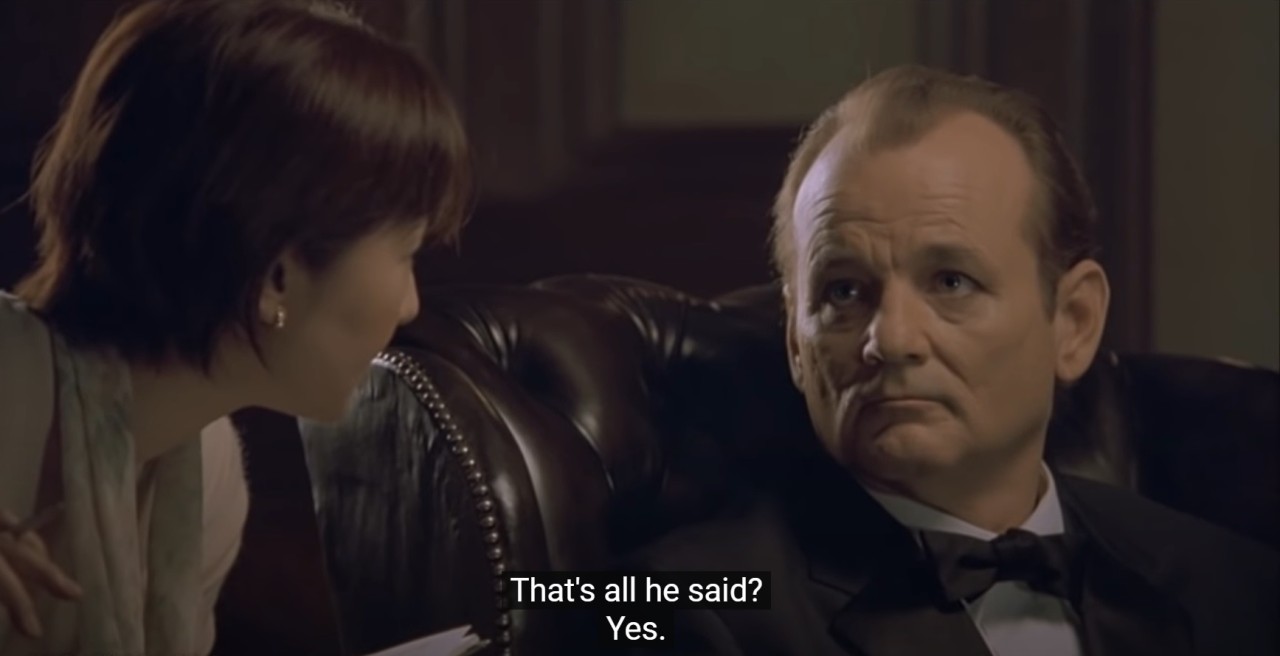
From 2003's "Lost in Translation" written and directed by Sofia Coppola, with Bill Murray as Bob Harris
From 2003’s “Lost in Translation” written and directed by Sofia Coppola, with Bill Murray as Bob Harris

Tl;dr: This week, a conversation with an executive underscored the complexities of communication and understanding in the workplace. I recalled that misunderstandings can lead to ineffective execution, and the ripple effects can be far-reaching and profound.

Talking past each other: Hidden pitfalls in workplace communications

I work with a number of managers and executives as a sounding board of sorts (mentor and coach are overused terms these days), and one of my friends in this category recently recounted a frustrating story working with their leadership team. As they embarked on a new project, they found themselves in a quagmire of miscommunication and misalignment. At the heart of the issue was the inability to establish clear asks and commitments among the various factions.

In their discussions, they wrestled with articulating expectations and securing consensus on deliverables. It was as if one team was speaking in French and the other in Italian – both beautiful languages, but with enough differences to cause confusion (particularly if you’re not bilingual). One team would outline and define work that was contingent on another group, but would fall short of ensuring that the latter knew of the requests and (more importantly) had accepted the challenges, or called out the bandwidth or capacity constraints that would make it impossible to do the work in the required timeframe.

It was as though they were ships passing in the night – both recognizing the importance of their tasks but unable to make needed concessions and commitments. Overall, disconnection was born out of poor communication, in part due to the challenges in a simple phrase that was bandied about:

“I understand.”

This scenario underscores the critical need for clear communication and mutual understanding in the workplace. Without it, even teams with the best intentions can find themselves at a crossroad, frustrated that the tasks don’t have a shared and understood commitment to get stuff done. It’s a stark reminder that in the world of work, clarity is not just about speaking, but ensuring our words are understood as we intended.

From Hollywood to Tokyo: Lesson in communication

I often share and leverage stories and scenarios found in popular books, cinema and television (we’ll leave my passion for Star Trek and Star Wars for another discussion, which you can see on full display in my post ‘To Boldly Go…’ from earlier this year.) The parables and analogies from these shared cultural experiences can help describe and illustrate key points. One of my favourites is from the film “Lost in Translation” which provides a poignant illustration of the complexities of cross-cultural communication.

Picture this: Bill Murray’s character, the famous actor Bob Harris, is on set on a Tokyo soundstage for a Japanese whiskey commercial. The director passionately articulates a series of intricate instructions… all in Japanese, which the translator then distills into a mere handful of English instructions. Bob is left adrift in a sea of confusion, unsure of his role and approach based on the sparse translation offered.

Director Sofia Coppola masterfully crafted the exchange in this scene, underscoring the challenges and idiosyncrasies navigating completely foreign language landscapes. She originally wrote the scene in English, had it translated into Japanese, and then purposefully kept Bill Murray in the dark about what the actual dialogue meant to capture his honest and transparent reaction.

This one moment encapsulates the essence of feeling “lost in translation” – and serves as a reminder that effective communication is more than just the words exchanged: you need to have an understanding and appreciation of context.

Communicating and learning on the job

Similarly, communication in the workplace can be hard, certainly more so when trying to cross cultural and time zone boundaries where we often find ourselves navigating a maze of nuances. I’ve often said that it’s easy to make something difficult to understand, but hard to make something simple and easily understood.

During one of my first business trips to Japan early in my career, I had the opportunity to work with and spend a great deal of social time with representatives from JETRO, Japan’s External Trade Organization. Before my trip, I’d read several books on Japanese phrases, business and cultural customs, and social events. I learned about the exchange of business cards, the art of the formal bow (and how low to go), and most importantly, nomikai – essentially, Japanese business dinners that are a fundamental part of Japanese culture. Think of it as a party where business colleagues eat and drink meals together (emphasis on the drinking), much as you may experience in the West but would be way beyond accepted HR margins. It’s a way to build relationships and develop trust, and there’s a lot of Japanese sake and beer at hand that helps serve as the mortar of these foundational meetings.

I’d developed a good relationship (which began months ahead of the visit over faxes and phone calls) with one of my counterparts. After several days and nights of areas of investment, cultural exchanges, and far too much sake, I shared there was a common phrase that many in our English-speaking delegation had heard from our Japanese hosts several times during the visit, but might misunderstand how it was used: “I understand”.

There’s a nuance in the interpretation of that simple phrase. In the Western world, it’s a synonym for agreement, and a quick nod of approval. But I’d come to learn in my trip preparations that “I understand” (in Japanese, loosely “wakari mash ta” ) was used in Japan more to acknowledge what you said was heard and comprehended… but not necessarily that there was any agreement.

Such a subtle difference can lead to misunderstandings when we bring different interpretations into the mix. And they don’t just happen overseas, but can occur when we miss subtle cues and misinterpret intentions.

“I Understand” can be a seemingly harmless landmine

After all, when it comes to bridging cultural divides, it’s not just about understanding each other; it’s about understanding each other better. Such subtle differences can be a source of confusion in teams, and not just multicultural ones. In the case of the simple phrase “I understand” (which many from outside the States have said is second only to the popular use of the common American response “No problem”), it’s like two ships passing in the night, unaware that they’re sailing on different courses.

In this case, the result was a lack of consensus, inefficient and frustrating communications riddled with inadvertent misunderstandings, all resulting in unclear commitments and deliverables. Bridging these gaps in meaning requires a blend of human insight and interpretation – as well as good old-fashioned engagement and precision questioning.

It’s also where the art of rethinking comes into play. We need to challenge our assumptions, question our interpretations, and most importantly, seek clarification. In doing so, we can bridge the gap between “I hear you” and “I agree with you”, fostering better understanding and collaboration in our diverse workplaces.

You may not be as good a communicator as you think

Effective communication in the workplace is the lifeblood of any organization, ensuring that everyone is equipped with the data and insights they need to be effective, foster a positive and collaborative work environment, improve trust, and eliminate inefficiencies. Without clear communication, misunderstandings can arise, leading to confusion, frustration, and decreased productivity.

And it can have an exorbitant cost.

In 10 Tips For Effective Communication In The Workplace, Christiana Jolaoso-Oloyede notes that ineffective communication can be costly for businesses. In the States, that check comes to $12,506 per employee per year, and a staggering $1.2 trillion annually, according to a report from Grammarly on the State of Business Communications. This underscores the importance of clear and effective communication in ensuring smooth operations and preventing unnecessary losses. (Jolaoso also includes the top tips for more effective communications and key skills you may need to incorporate.)

In his article Half Of All Meetings Are A Waste Of Time – Here’s How To Improve Them, Peter High discusses the inefficiency of many workplace meetings, citing that with ~55 million meetings happening every day, at least half of them don’t accomplish very much. Steven Rogelberg, a management professor at UNC Charlotte, suggests that many of the people leading the meetings think that they are better at communicating the goals and running meetings than they really are, significant blind spots that many don’t see. Improving the understanding of the W5 for meetings (particularly the why and the what) would help improve effectiveness and productivity.

Clear Communication in Workplace: Key to Success on Wrike.com emphasizes that the critical role of understanding what’s communicated is a crucial aspect of effective communications. It helps ensure expectations are clear and enabled constructive feedback to be provided, particularly in how leaders drive and endorse the effort.

“The breakdown in collaboration and coordination can give way to missed deadlines, duplication of work, and decreased productivity. Employees may become frustrated with their colleagues, feel that their voices are not being heard, or that they do not have access to the information needed to complete their tasks. Furthermore, poor communication direct impacts customer satisfaction.”

When employees understand the what, they can contribute to the how: improving processes, solving problems, driving productivity, and building a strong organizational reputation. When everyone in an organization understands their roles, responsibilities, and expectations WRT shared outcomes, it helps creates a better and more effective work environment conducive to success.

So, the next time you find yourself getting lost in translation, take a step back. Take the time to understand not just the words spoken, but the intent behind them. Every conversation is an opportunity to learn and grow: embrace the differences and use them to be clear and communicate more effectively. After all, it’s not just about understanding each other; it’s about understanding each other better and building truly effective, inclusive, and productive relationships.

And at dinner in Japan, remember to fill your neighbour’s cup, but don’t fill your own.

#Rethink #Diversity #LostInTranslation #Communication

(Originally posted on LinkedIn)

Categories
Communicating

Nemawashi: The Japanese Art of Making Change Happen

Artwork courtesy Stable Diffusion

(Preface: Some will recall that I published a large OneNote resource of articles and publications assembled over the years, complete with PowerPoints and Word white papers – if you’re still on the Microsoft network, you may find it still there. And I plan to share some of those ideas and musings from there, or at least as much as I can recall.)

Change is inevitable, but it is also often difficult and stressful.

I recounted this stress once again with the recent death of a cousin over the summer. I’d connected and emotionally supported Chance as he bravely (and with a smile and good humour) fought a cancer that had come back to haunt him. (I thought a lot about change over the summer, and – perhaps somewhat surprisingly to many – in the same breath, death: one of the most universal and inevitable experiences that we all face. I’ll talk about his in more detail in my next post. Yay. I promise it will be more uplifting and positive than you might imagine.)

Not everything in business our professional lives is life and death, but we often face challenging obstacles that we strive to overcome. In business, it can be the resistance or opposition we encounter when we try to introduce a new idea or perspective, or when we want to implement a new project or plan – windmills I tended to tilt at a lot in my last role at Microsoft, representing the needs of our global customers and partners balanced with the goals of a public company, delivering improved revenue, consumption and market share.

How can we overcome these challenges and make change smoother and more successful?

One possible answer: nemawashi.

Nemawashi is a term my teams, peers, and leaders heard me use time and time again (apologies 😉 when I’d explain how I gotten something (often, quite challenging politically and operationally) accomplished. It’s a concept that can help us rethink how we approach change, and stems from the Japanese word for “going around the roots”, referring to a gardening technique of preparing a plant for transplantation by carefully digging and trimming its roots.

It was explained to me by a long time Toyota executive that the term originated with bansai tree masters as their effort to cultivate prime specimens. There’s an interesting summary on nemawashi in The Toyota Way, here, and here on the approach, and a practical guide to apply it in in your day-to-day work. In the kaizen (continuous improvement) of business management, it’s about building and getting consensus on a project in advance and then acting quickly.

Tl:dr: nemawashi makes it easier for the plant to adapt to a new soil and thrive in a different environment. And so, it can help you be more successful in getting to consensus and synthesizing new ideas and direction from others.

In the business world, nemawashi is a strategy of building consensus and support for a proposed change or project by talking to the people who are affected or involved in the decision-making process. Think of it to gather feedback and suggestions from various stakeholders before making a formal announcement or presentation, or the “meetings before the meeting” where the work is formally agreed to or memorialized. It helps avoid conflicts and resistance by making people feel more comfortable and confident about the change and its benefits.

Nemawashi is not only a useful technique for managing change in organizations, but also for changing minds in general. When we want to persuade someone to adopt a new idea or perspective, we often make the mistake of assuming that they will be convinced by our logic and evidence. I’ve read and heard that people are more likely to resist or reject information that challenges their existing beliefs or opinions… especially if they feel threatened or attacked by it.

To overcome this impediment, nemawashi can be practiced in our conversations and interactions to listen to their concerns and understand their perspectives rather than having them feel we’re trying to prove them wrong or force them to agree with us (seen much too often in competitive and stack-ranked organizations). Showing people that we respect their opinions and value their input to improve or modify the proposals or approach makes them feel more a part of the solution, not the problem.

By doing nemawashi, we can create a more open and constructive dialogue with others, where we can exchange information and opinions without being defensive or hostile. We can also learn from each other and discover new insights and possibilities that we might have overlooked or ignored. Nemawashi can help us foster collaboration and trust among the people we want to influence or persuade, as well as among ourselves. And it can help us think again about how we handle change and how we change minds.

How has such an approach helped you? Tell me what you’ve found and think in the comments.

(Also on LinkedIn)